Overview
LifeOS is not a collection of AI features bolted onto a terminal. It’s an operating system in the literal sense: a layer that sits between you and the machine, schedules work, manages state, and gives every other program a consistent way to run.
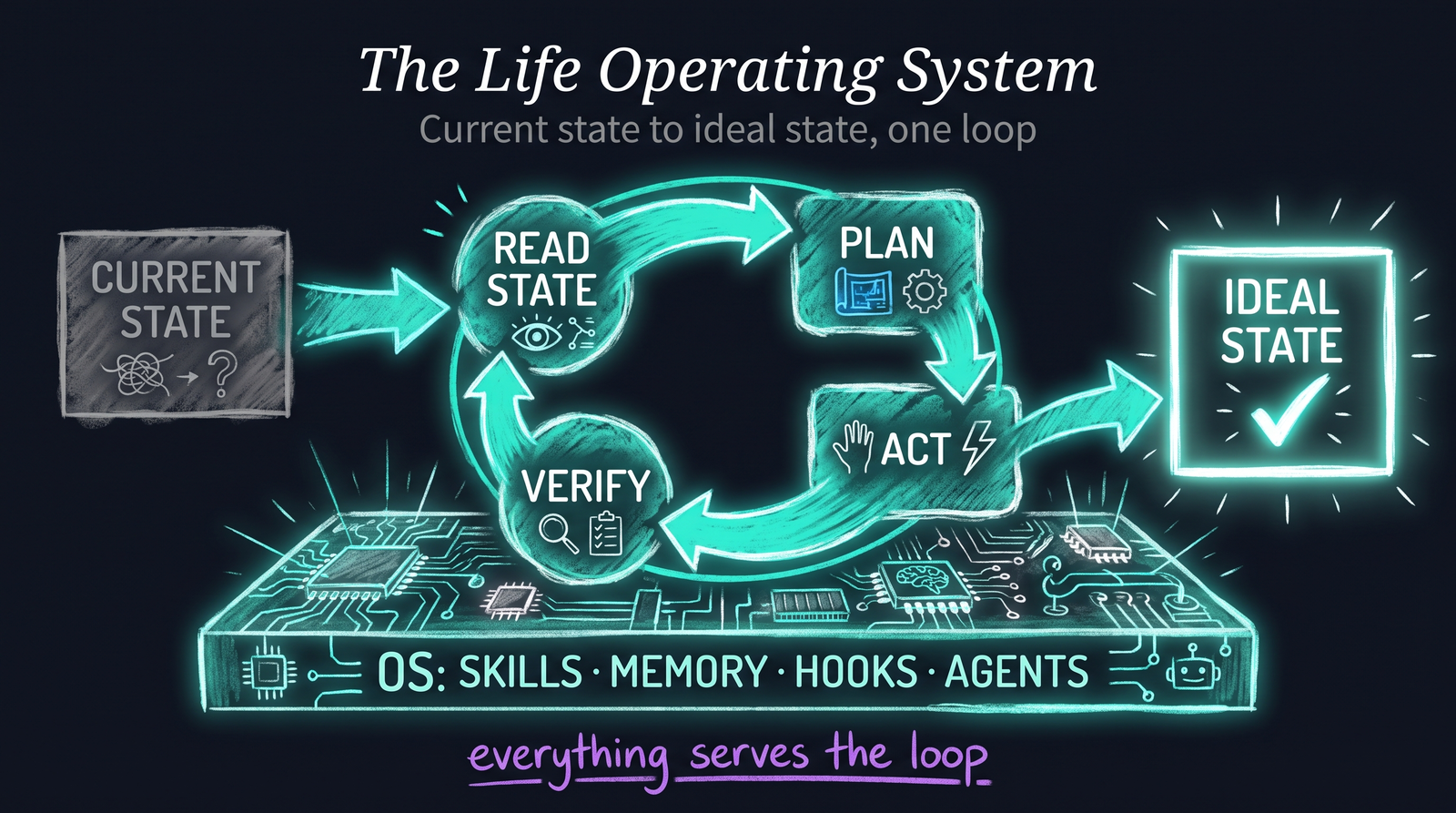
The job of an operating system is to move a system from where it is to where it needs to be, reliably, and to keep doing that as conditions change. LifeOS does the same thing for a person. It reads your current state, holds your ideal state, and runs the loop that closes the gap between them. Skills, hooks, memory, agents—all of it exists to serve that one loop, not to exist for its own sake.
This is why the name matters. “AI assistant” describes a chat window that answers questions. “Operating system” describes something that runs underneath everything you do, manages resources, and keeps working when you’re not looking at it.
Why This Matters
Without the operating-system frame:
- Every new capability becomes a standalone feature with its own logic
- There’s no shared notion of “state” that skills can read and write
- Progress toward goals isn’t tracked between sessions—each conversation starts from zero
- The system optimizes for interesting demos instead of closing real gaps
With the operating-system frame:
- Every subsystem inherits the same current-state-to-ideal-state contract
- Skills, memory, and hooks compose because they share one substrate
- Work persists and accumulates across sessions instead of resetting
- New capabilities get evaluated by one question: does this help close the gap
Implementation
In LifeOS, this manifests through:
TELOS - The ideal-state half of the loop. Missions, goals, problems, and strategies live in one file the system reads every session, so “ideal state” isn’t an abstraction—it’s a concrete, checkable document.
The Algorithm loop - The execution half. Observe current state, compare against the ideal, hill-climb the gap, verify with evidence. This is the OS scheduler: it decides what runs next and why.
The ISA (Ideal State Artifact) - Every project gets its own local ideal state, with testable claims and falsifiers, so the current-to-ideal loop operates at the project level as well as the life level.
Hooks - Deterministic enforcement that runs underneath conversations, the same way an OS kernel enforces rules underneath applications—without asking permission each time.
Examples
Example 1: Feature vs. OS thinking
- Feature framing: “Add a reminder skill”
- OS framing: “Reminders are one more way state changes get written back to TELOS and surfaced by Pulse”
Example 2: A new subsystem
- Wrong question: “Would this be a cool thing to build?”
- Right question: “Does this move current state closer to ideal state, and can it be verified?”
Example 3: Session boundaries
- Without the OS frame: each session is a fresh chat with no memory of the goal
- With the OS frame: Cortex and TELOS carry state forward, so session N+1 picks up exactly where N left off
Related Principles
- Principle #3: Deterministic Where Possible - The OS substrate is code and gates, not vibes, wherever it can be
- Principle #12: History System - Persistent state across sessions is what makes an OS an OS instead of a chat window
- Principle #1: Clear Thinking + Prompting is King - Ideal state has to be articulated clearly before the loop can close on it