
Overview
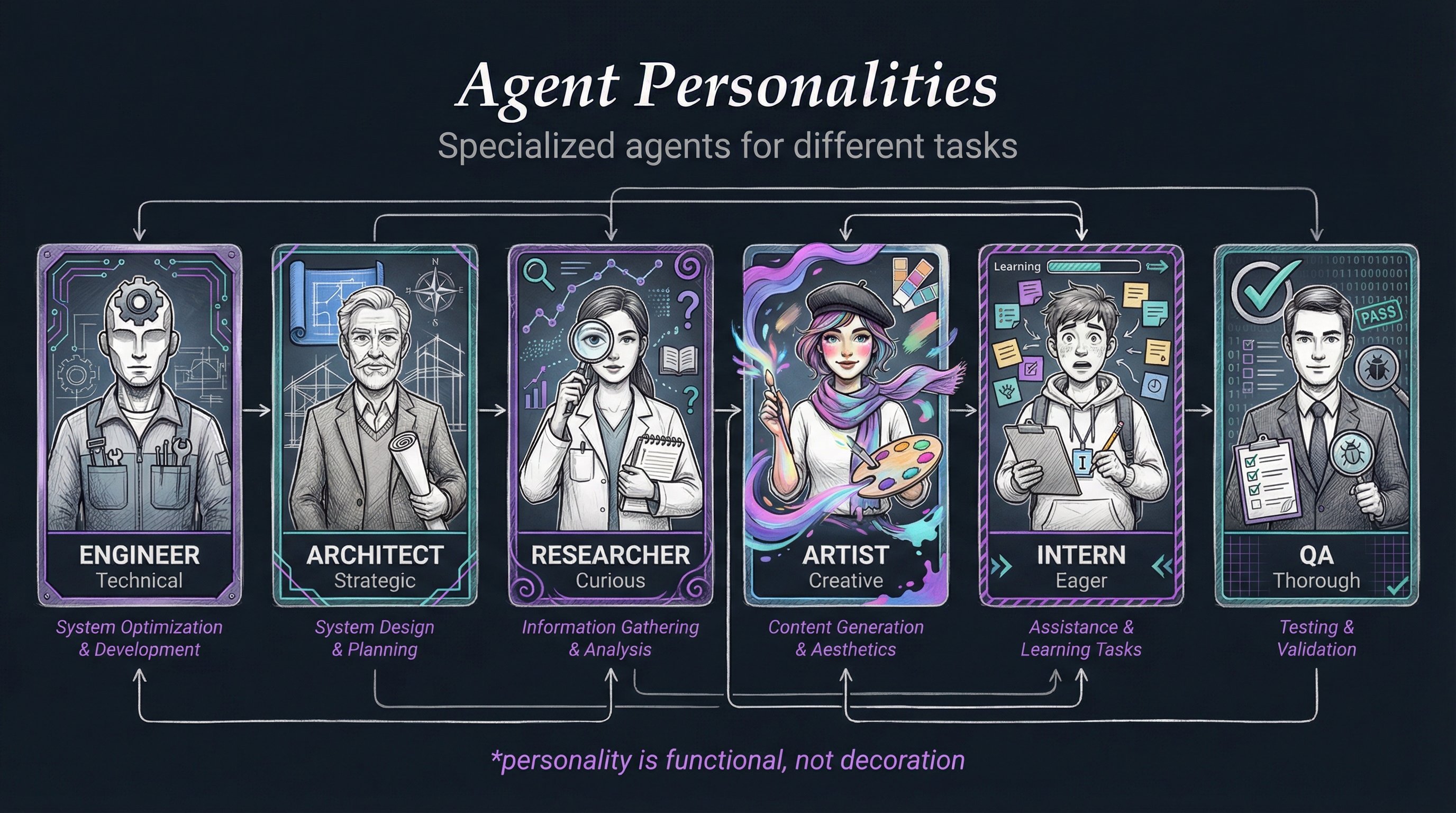
Specialized agents with distinct personalities for different tasks. Personality isn’t decoration—it’s functional.
Different work needs different approaches. Engineering requires systematic rigor. Research demands critical analysis. Design needs aesthetic judgment. QA testing needs adversarial thinking.
Custom agents aren’t about making AI “fun” or “relatable.” They’re about giving AI the right mindset, expertise, and constraints for specific types of work.
Why This Matters
Context switching is expensive - When one agent does everything, it carries inappropriate context. The researcher brings too much skepticism to engineering. The engineer brings too much rigidity to design.
Expertise requires specialization - A general-purpose agent knows a little about everything. Specialized agents develop deep expertise in their domains.
Constraints prevent mistakes - The Engineer agent won’t deploy without tests. The QA agent won’t approve without finding edge cases. Constraints embedded in personality prevent errors.
Voice clarity improves communication - Different agents sound different. This isn’t cosmetic—it signals what mode you’re in and what to expect.
Implementation
LifeOS defines agents in .claude/Agents/ with complete personalities:
Agent Structure:
Agents/
├── Engineer.md              # TDD-focused implementation agent
├── Architect.md             # System design and planning
├── Designer.md              # UX/visual design
├── QATester.md              # Adversarial testing
├── ClaudeResearcher.md      # Research with Claude
├── GrokResearcher.md        # Research with Grok
└── PerplexityResearcher.md  # Research with Perplexity
Each agent defines:
1. Identity and Role
- Who they are
- What they’re expert at
- What they refuse to do
- Model preference (Opus for architecture, Sonnet for engineering)
2. Knowledge and Context
- Domain expertise files
- Required skills
- Standard workflows
- Best practices
3. Voice and Style
- TTS voice ID (ElevenLabs)
- Communication patterns
- Output formats
- Tone and personality
4. Constraints and Safety
- What they won’t do
- When they escalate
- Constitutional compliance
- Testing requirements
Examples
Example 1: Engineer Agent
- Personality: Systematic, test-driven, constitutional compliance
- Voice: Technical precision, frequent progress updates
- Constraints: No code before tests, browser validation for web apps
- Use case: Implementing features with production-grade quality
- Model: Sonnet 4.5 (fast, cost-effective for iteration)
Example 2: Architect Agent
- Personality: Strategic, long-term thinking, trade-off analysis
- Voice: Thoughtful, questioning, explores alternatives
- Constraints: Won’t approve designs without considering scale
- Use case: System design, technical decision-making
- Model: Opus 4.5 (deep reasoning for complex decisions)
Example 3: Designer Agent
- Personality: User-focused, aesthetic judgment, accessibility
- Voice: Visual thinking, empathy for user experience
- Constraints: Won’t approve interfaces without accessibility review
- Use case: UX design, visual polish, interaction patterns
- Model: Sonnet 4 (good balance for creative work)
Example 4: QA Tester Agent
- Personality: Adversarial, edge-case focused, never satisfied
- Voice: Critical, thorough, finds problems others miss
- Constraints: Won’t approve without comprehensive test coverage
- Use case: Breaking things, security testing, quality assurance
- Model: Sonnet 4 (systematic testing doesn’t need Opus)
Example 5: Multi-Agent Workflows
- Architect designs system architecture
- Engineer implements with TDD
- Designer reviews UX and visual quality
- QA Tester breaks everything
- Engineer fixes issues
- Loop until QA approves
Each agent brings domain expertise and appropriate constraints.
Related Principles
- Principle #11: Custom Skill Management - Agents use skills for their work
- Principle #2: Scaffolding > Model - Agent personalities are scaffolding
- Principle #1: Clear Thinking + Prompting is King - Clear agent roles improve thinking