Overview
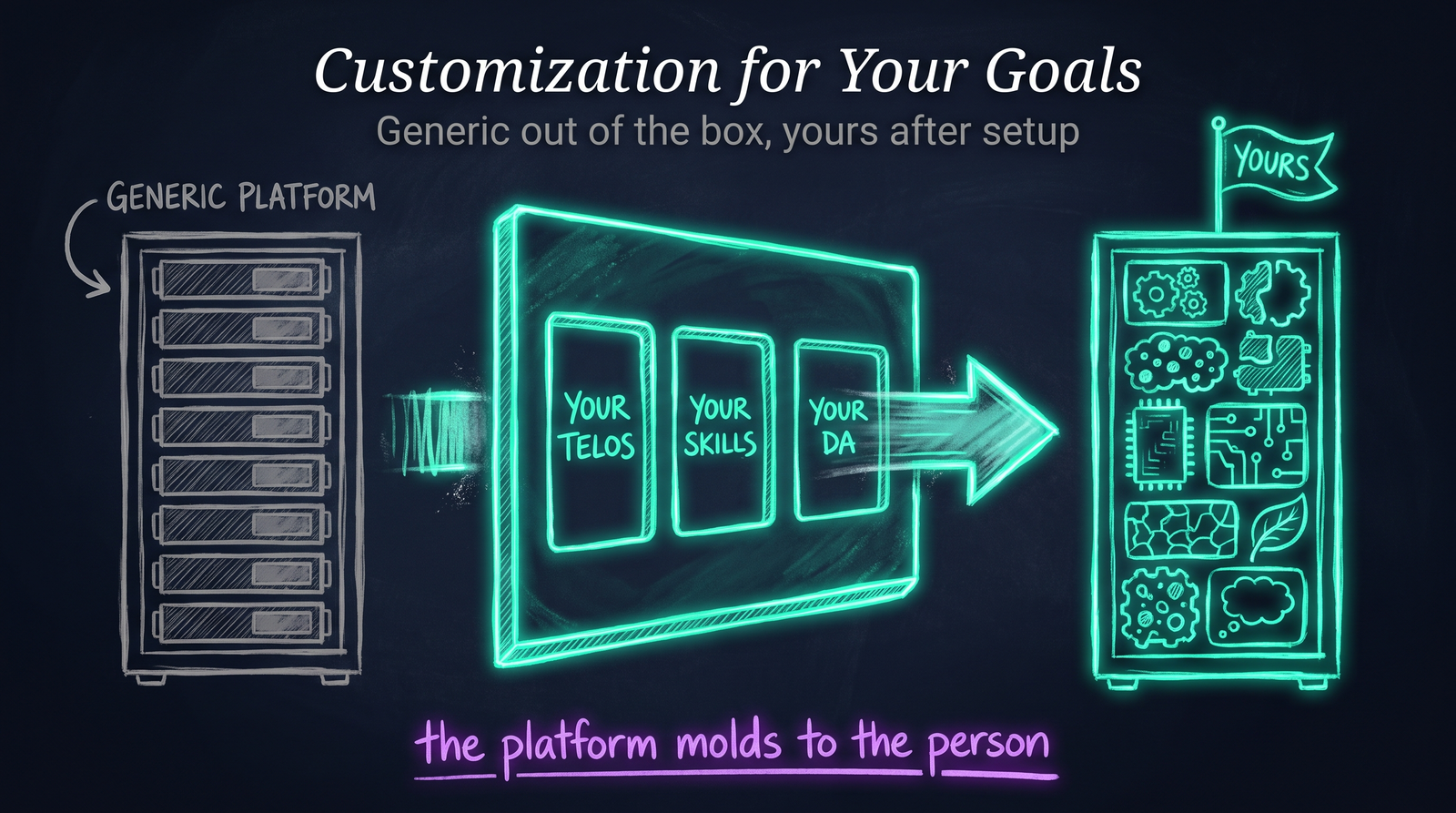
Most software asks you to fit yourself into its shape. You adapt your workflow to the tool. LifeOS inverts that: it ships generic and gets shaped by you, once, at setup, and then keeps shaping itself as you change.
The platform is agentic infrastructure—skills, agents, memory, hooks—but infrastructure alone doesn’t achieve anyone’s goals. What achieves goals is that same infrastructure pointed at your specific TELOS, running your specific skills, speaking with your DA’s specific identity. Two people running LifeOS end up with two different systems, because the customization layer is what turns a platform into a life operating system for one particular life.
This isn’t personalization as a feature flag. It’s the actual mechanism by which the system becomes useful: a blank agentic platform can do almost anything and therefore does nothing in particular. Pointed at your goals, it does exactly what you need.
Why This Matters
Without customization:
- Every install behaves identically regardless of what the person actually wants
- Skills either don’t exist for a person’s specific needs or exist as generic, unhelpful defaults
- The DA has no identity, no memory of the principal, no voice of its own
- Goals live outside the system, so the system can’t route work toward them
With customization:
- The system routes work using your actual TELOS, not a generic template
- New skills get built for your specific recurring needs
- The DA develops an identity and a relationship with you specifically
- What the system does on day 400 reflects everything it learned about you since day one
Implementation
In LifeOS, this manifests through:
TELOS - Your missions, goals, problems, and strategies, read every session. This is the file that turns generic execution into execution toward your goals specifically.
CreateSkill - The mechanism for extending the platform with capabilities that don’t exist anywhere else, because they’re built for one person’s recurring work.
DA Identity - The digital assistant’s name, personality, and voice are set once and then evolve, so the same underlying platform produces a genuinely different assistant for each principal.
Cortex (Memory) - Autonomic capture and curation of what matters to you specifically—contacts, preferences, decisions—so the system’s behavior compounds instead of resetting.
Examples
Example 1: Generic vs. customized routing
- Generic: a support bot that answers the same way for every user
- Customized: a DA that knows your active goals and routes a request toward the one it actually serves
Example 2: Skill creation
- Generic platform: “There’s no built-in way to track my specific business’s credit card points”
- Customized platform: a skill built for exactly that, reading your actual card list and balances
Example 3: Day one vs. day 400
- Day one: fresh install, no memory, default identity, empty TELOS
- Day 400: a DA with a name and voice, a TELOS full of real goals, and dozens of skills built for problems only you have
Related Principles
- Principle #14: LifeOS is the Life Operating System - Customization is how the generic OS becomes an OS for one specific person
- Principle #11: Skill Management - Skills are the primary unit of customization
- Principle #9: Goal → Code → CLI → Prompts → Agents - Customization starts from your goals and works down to implementation