
Overview
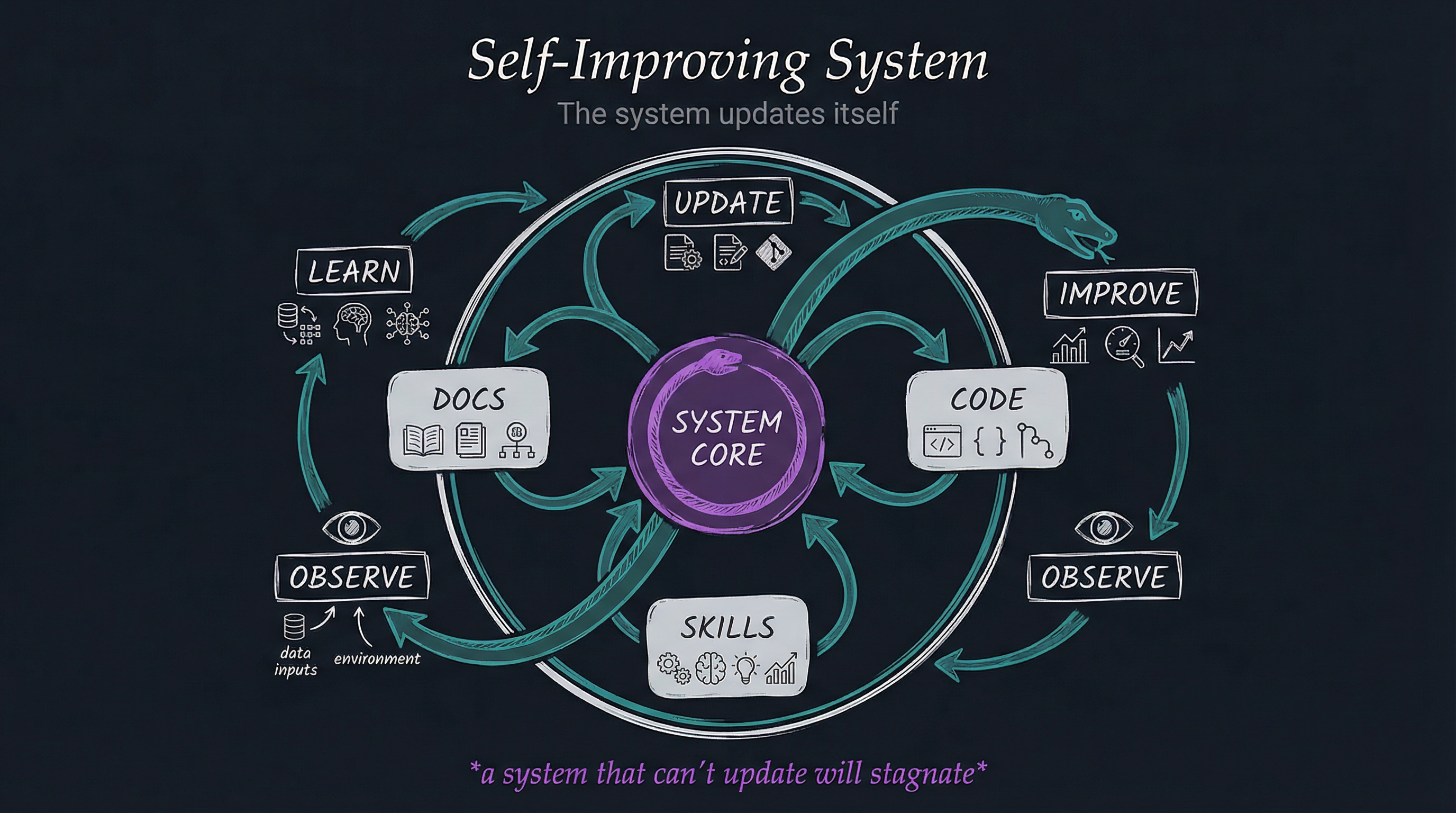
The system should be able to improve itself. A system that can’t update itself will stagnate.
This isn’t about AI becoming sentient or autonomous. It’s about systems that can analyze their own patterns, identify improvements, and implement upgrades systematically.
Your AI should get better over time by learning from your work, encoding discovered patterns, and updating its own capabilities.
Why This Matters
Manual updates don’t scale - When you discover a better pattern, you shouldn’t manually update 50 skills. The system should update itself.
Patterns emerge from use - You don’t know the best workflows upfront. You discover them. The system should capture and encode successful patterns.
Knowledge compounds - Every improvement makes future improvements easier. Systems that learn get exponentially better. Systems that don’t learn stay static.
Maintenance becomes automatic - When the system maintains itself, you focus on new capabilities instead of tending existing ones.
Implementation
LifeOS implements self-improvement through multiple mechanisms:
History System (Principle #12) - Automatic capture of sessions, learnings, and decisions creates searchable knowledge. The system learns from its own history.
Upgrade Skill - Dedicated skill for extracting LifeOS improvements from content. Systematically analyzes work and identifies upgrade opportunities.
Learning Capture - Hooks automatically save learnings to History/learnings/. Patterns get encoded as skills, templates, or workflows.
LifeOS Update System - /paiupdate command fetches latest upstream, analyzes differences, generates personalized merge report. Your AI orchestrates the update.
Skill Templates - CreateSkill skill generates new skills from templates. Template improvements benefit all future skills.
Meta-Prompting - Prompting skill contains systems for dynamic prompt generation. Prompt improvements cascade everywhere.
Examples
Example 1: Pattern Discovery
- You solve a problem manually multiple times
- History system captures each solution
- AI identifies the pattern: “This keeps recurring”
- Upgrade skill extracts the pattern
- CreateSkill generates a new skill encoding the solution
- Next time the problem appears, it’s automated
Example 2: Workflow Improvement
- Research workflow completes but takes too long
- AI analyzes the workflow execution
- Identifies bottleneck: Sequential when it could be parallel
- Updates workflow to run sources in parallel
- Next research runs 3x faster
- Improvement captured to template for future skills
Example 3: Template Evolution
- You create 10 skills, notice repeated patterns
- AI analyzes common structure
- Extracts pattern into reusable template
- Updates CreateSkill to use improved template
- Next skill generation uses better structure
- Retroactively suggests improvements to existing skills
Example 4: Error Pattern Recognition
- Same API error occurs in 3 different skills
- AI recognizes pattern: Rate limiting
- Creates shared retry-with-backoff library
- Updates all affected skills to use library
- Adds rate-limit handling to skill template
- Future skills include it by default
Related Principles
- Principle #12: Custom History System - History enables learning
- Principle #11: Custom Skill Management - Skills are what get updated
- Principle #7: ENG / SRE Principles - Updates require reliability practices