
Overview
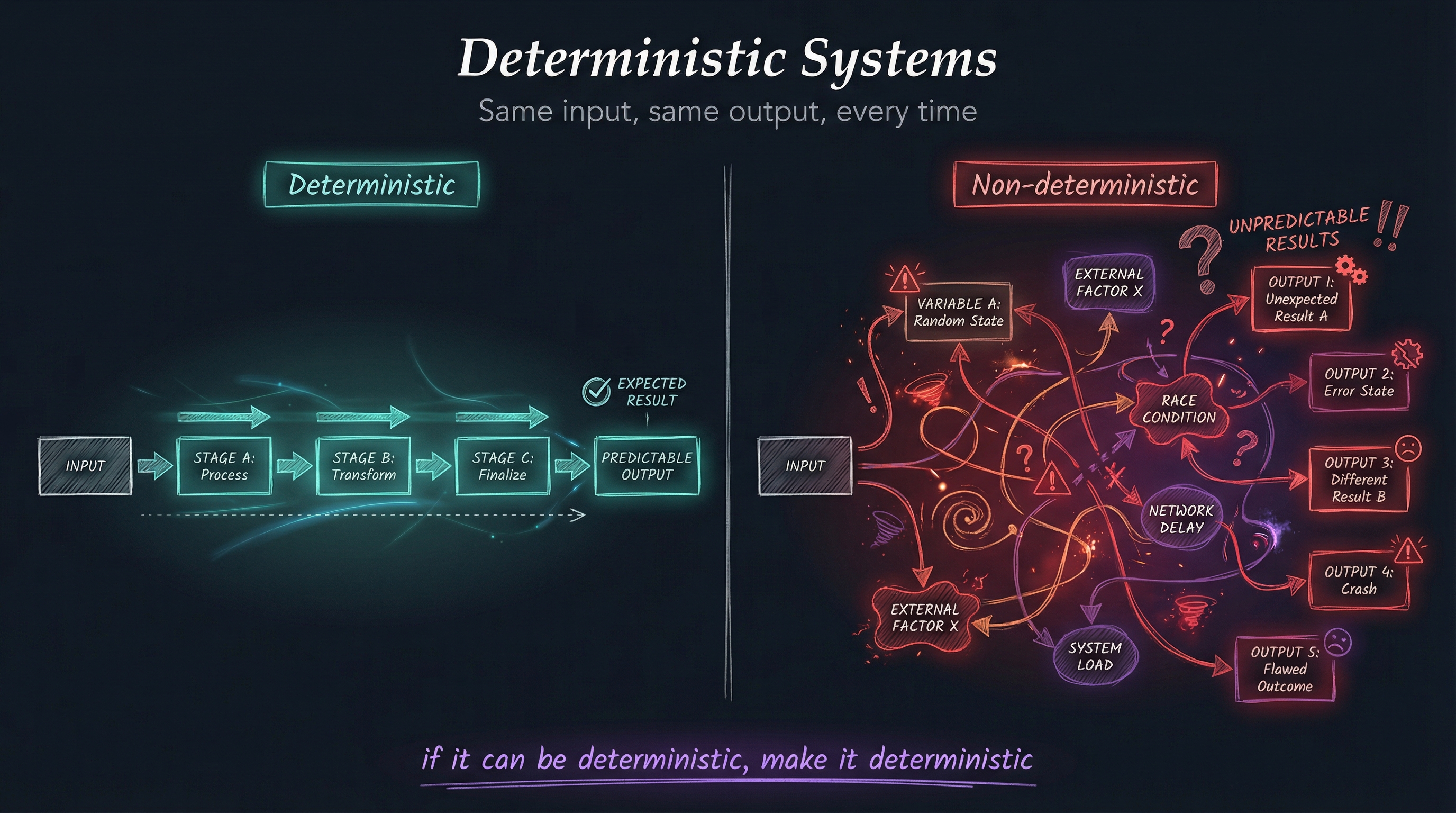
Favor predictable, repeatable outcomes over flexibility. Same input → Same output. Always.
AI systems are inherently probabilistic. That’s fine for creative work, but catastrophic for infrastructure. The goal isn’t to eliminate randomness entirely—it’s to constrain it to where it adds value and eliminate it everywhere else.
Using templates and code produces reliable, repeatable results rather than probabilistic outputs. When you can predict what happens, you can test it, automate it, and trust it.
Why This Matters
Reliability requires determinism - Systems you can’t predict are systems you can’t trust. Production infrastructure demands predictability.
Testing requires determinism - You can’t write meaningful tests for systems that produce different outputs from identical inputs.
Automation requires determinism - Unpredictable systems can’t be safely automated. You need human review loops, which destroy productivity.
Debugging requires determinism - When behavior changes randomly, root cause analysis becomes impossible. You’re reduced to superstition and prayer.
Implementation
LifeOS enforces determinism through multiple layers:
Code Over Prompts (Principle #4) - Deterministic code first, prompts only when necessary. Code executes identically every time.
Template System - Reusable prompt templates in the Prompting skill. Templates produce consistent structure even with variable content.
Structured Workflows - Skills contain explicit workflows with defined steps. Same workflow → same process → predictable outcomes.
Configuration Management - settings.json for identity and paths, .env for API keys. Configuration is explicit, versioned, and portable.
Test-Driven Development - Tests define expected behavior. Implementation must match specifications. No surprises.
CLI as Interface (Principle #8) - Command-line tools are deterministic. GUI interactions are not. command args always does the same thing.
Examples
Example 1: Web Scraping
- Non-deterministic: “Scrape this website” → different parsing each time → unreliable data
- Deterministic: BrightData skill with four-tier progressive fallback → explicit tier selection → consistent parsing → validated output
Example 2: Content Generation
- Non-deterministic: “Write a blog post about X” → wildly different results → inconsistent voice → unpredictable quality
- Deterministic: Content template with defined structure + tone guidelines + examples → consistent voice → predictable quality → testable output
Example 3: Code Review
- Non-deterministic: “Review this code” → random observations → missed critical issues
- Deterministic: Code review checklist → security scan → test coverage check → style validation → reproducible analysis
Related Principles
- Principle #4: Code Before Prompts - Code is deterministic, prompts are probabilistic
- Principle #5: Spec / Test / Evals First - Specifications define deterministic behavior
- Principle #7: ENG / SRE Principles - Production systems demand determinism