
Overview
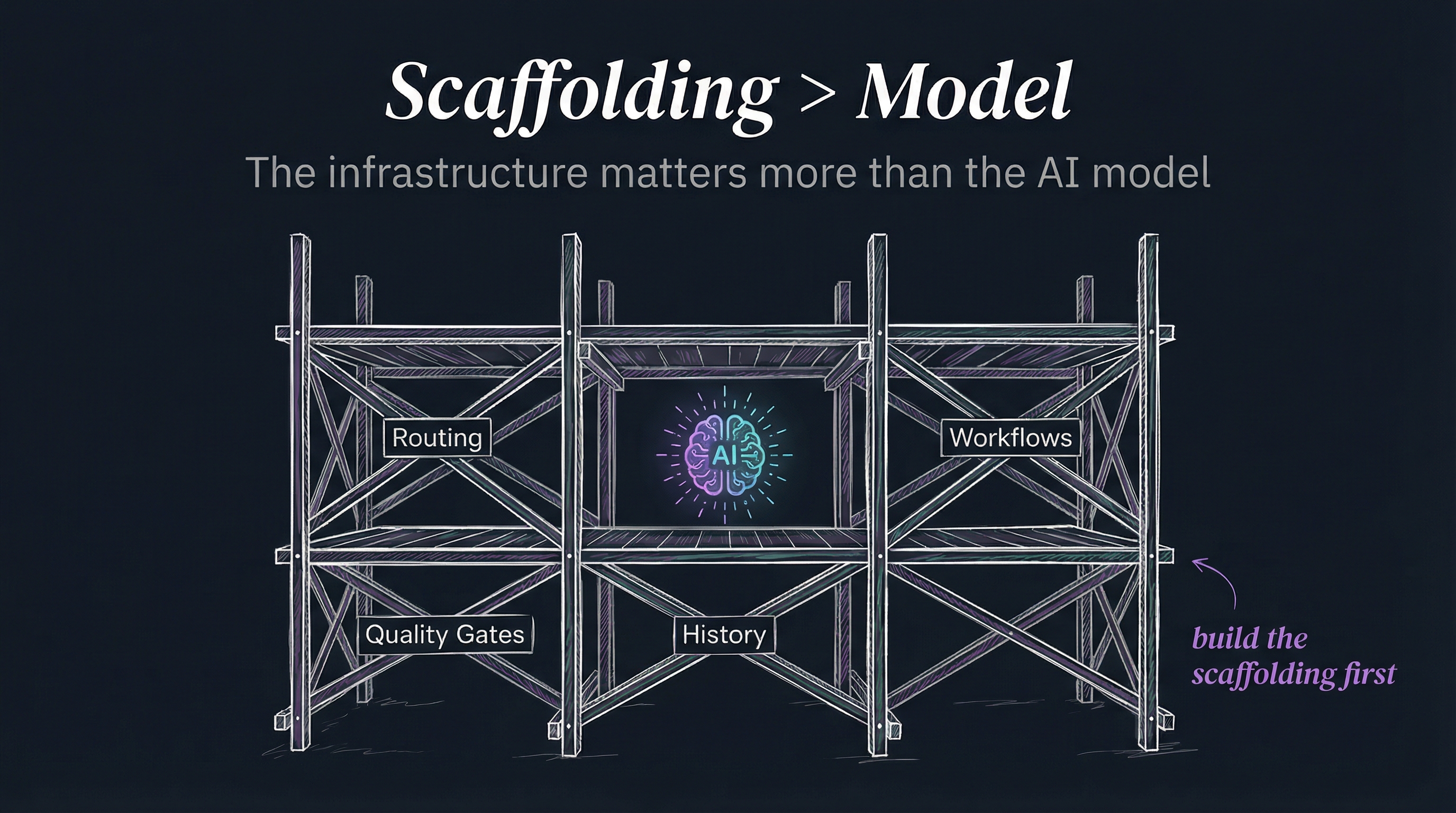
The system architecture matters more than the underlying AI model. A well-structured system with good scaffolding will outperform a more powerful model with poor structure.
This isn’t theoretical—it’s observable reality. A mediocre model with excellent context management, clear workflows, and proper tool integration consistently outperforms a brilliant model with none of that infrastructure.
The scaffolding is what makes AI reliable, predictable, and useful. The model provides raw capability. The scaffolding provides control, context, and consistency.
Why This Matters
Raw models are commodities - GPT-4, Claude Opus, Gemini Pro—they’re all exceptional. The competitive advantage isn’t the model; it’s the infrastructure around it.
Scaffolding provides leverage - A 10x improvement in prompting yields maybe 20% better results. A 10x improvement in scaffolding yields 500% better results because it amplifies everything.
Models change constantly - New models release every few months. Scaffolding built correctly outlasts models by years.
Scaffolding enables portability - LifeOS runs on Claude Code today. Tomorrow it could run on OpenCode, custom implementations, or platforms that don’t exist yet. The scaffolding remains valuable.
Implementation
LifeOS implements this through layered infrastructure:
Skills System - Self-contained packages with routing, workflows, context, and documentation. Skills persist across model upgrades.
Hook System - Event-driven automation that captures work and manages state. Hooks work regardless of which model processes the events.
History System (UOCS) - Unified observation and context persistence. Your accumulated knowledge outlives any specific model.
Agent Personalities - Specialized configurations for different tasks. The personality structure survives model changes.
MCP Integration - Model Context Protocol provides standardized tool access. The protocol layer shields you from model-specific implementations.
Platform Agnostic Design - process.env.DA for identity, ${PAI_DIR} for paths, configuration separation—everything designed to migrate cleanly.
Examples
Example 1: Research Workflow
- Weak scaffolding: “Research AI trends” → random web browsing → inconsistent notes → no structure
- Strong scaffolding: Research skill with 10 specialized workflows → multi-source parallel execution → automatic capture to history → structured output → searchable knowledge base
Example 2: Code Generation
- Weak scaffolding: Ask for code → get code → copy/paste → hope it works
- Strong scaffolding: Spec-first workflow → TDD with tests before code → automated validation → git integration → automatic documentation capture
Example 3: Content Creation
- Weak scaffolding: Generate blog post → manual editing → lost drafts → no version control
- Strong scaffolding: Art skill for diagrams → content templates → automated formatting → git workflow → automatic deployment pipeline
Related Principles
- Principle #3: As Deterministic as Possible - Scaffolding creates determinism
- Principle #6: UNIX Philosophy - Modular scaffolding enables composition
- Principle #12: Custom History System - History is scaffolding that compounds over time